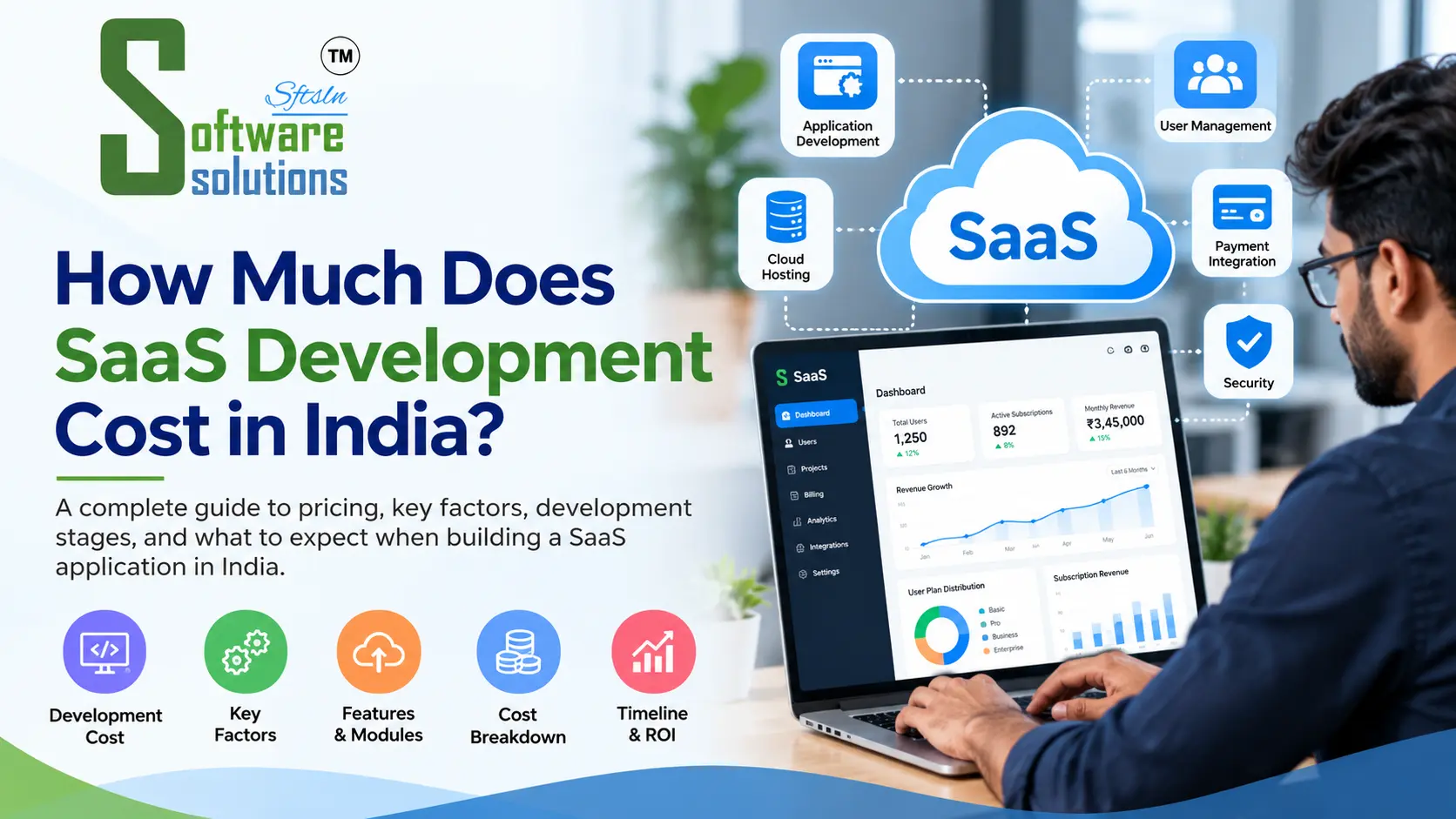
Businesses looking for SaaS application development services often want to understand the expected development cost before starting a project, and honestly, that's the right instinct. The trouble is, "how much does SaaS cost" doesn't really have a single answer, because a SaaS product can mean a simple tool with three screens or a full platform with a dozen integrations and its own mobile app. Both get called "SaaS." Both cost wildly different amounts.
Rather than throw out a number that won't actually mean much without context, here's what genuinely drives SaaS development cost in India, so you can walk into a conversation with a development partner already knowing what questions to ask.
Typical Factors Affecting SaaS Development Cost
A handful of things move the cost more than anything else: how complex the core product actually is, how many different types of users it needs to support, how much custom design work goes into it, how many other systems it needs to connect with, how much infrastructure and security work it takes to run safely for many customers at once, and how much ongoing support you want built in from the start.
None of this is unique to SaaS exactly, but SaaS tends to touch more of these at once than a typical custom software project does, which is part of why costs can swing so widely.
SaaS MVP vs Full-Scale SaaS Platform
This is probably the single biggest lever you have. An MVP, a minimum viable product, covers just the core idea, the thing that actually proves people want what you're building, nothing more. A full-scale platform tries to cover every feature you can imagine from day one.
Starting with an MVP isn't a compromise, it's usually the smarter move even if budget weren't a concern, because it gets something real in front of users faster, and what you learn from them tells you far more about what to build next than guessing upfront ever could. It's also, unsurprisingly, a lot cheaper than trying to build everything at once.
UI/UX Development
Design work scales with how customer-facing your product is. An internal tool your own staff will use doesn't need the same polish as a product paying customers will judge within their first few minutes of using it. For a genuine SaaS product you're planning to sell, decent UX isn't optional, a confusing first experience loses signups before they ever see what the product can actually do, but it's worth being deliberate about where that design effort actually goes rather than polishing every corner equally.
Backend and Database Development
This is the part nobody sees but everything depends on. How your data is structured, how efficiently the system handles requests, how cleanly it's built to grow, all of this sits in the backend. A simple product with straightforward data needs is a much smaller job here than one handling complex relationships between lots of different kinds of data, or processing a high volume of activity.
Authentication and User Management
Every SaaS product needs a secure way for people to sign up, log in, and, depending on the product, have different permission levels within their own account. This sounds simple and usually is for a basic version, but it gets more involved once you need things like team accounts with multiple users, different roles, or single sign-on support for bigger business customers.
Subscription and Payment Integration
Since SaaS is usually billed on a recurring basis, you need proper handling for subscriptions, renewals, upgrades, downgrades, and what happens when a payment fails or someone cancels. Integrating with a payment provider isn't usually the hardest part, it's building the logic around plans, billing cycles, and edge cases properly that takes real time.
Admin Dashboard
Beyond what your customers see, you'll likely need your own internal dashboard, a place to see who's signed up, manage accounts, handle support issues, and keep an eye on how the product's actually being used. This is easy to underestimate in early planning, but it's genuinely necessary infrastructure for running the business behind the product, not just an optional extra.
Third-Party API Integrations
If your product needs to connect with other tools, say an accounting platform, a messaging service, or something industry-specific your customers already use, each integration adds real development and testing time. Some are well documented and straightforward. Others are older or poorly documented and take considerably longer than expected. Listing these clearly upfront avoids a nasty surprise partway through the project.
Cloud Hosting and Infrastructure
SaaS products run on cloud infrastructure, and getting this set up properly, not just functionally, but in a way that scales reasonably as you grow, is its own meaningful piece of work. This includes planning for how the system handles more users over time, not just how it performs with the handful of people testing it early on.
Security
Security matters more for SaaS than for a lot of other software, because you're holding data for potentially many different customers inside one system. Proper data separation, access control, and general security practices aren't a feature you add later, they need to be built in from the start, and that takes real, deliberate effort rather than an afterthought bolted on before launch.
Testing and Deployment
Testing a SaaS product means checking it holds up under real, messy usage, multiple accounts, multiple users, things happening at the same time, not just a clean, single-user demo. Deployment, getting the product actually live and accessible reliably, is its own piece of work too, particularly the first time it happens for a brand new product.
Maintenance and Ongoing Development
SaaS development doesn't really end at launch. There's ongoing maintenance, bug fixes, security updates, and continued feature development as you learn from real users. This is a genuinely different, longer-term cost than a one-off custom project that's mostly finished once delivered, and it's worth budgeting for honestly rather than treating launch as the finish line.
Development Timeline
Timeline and cost move together, for largely the same reasons. A focused MVP can move considerably faster than a full platform, and the same factors that drive cost, complexity, integrations, design depth, also drive how long the project actually takes. A realistic timeline should come from a proper conversation about your specific scope, not an assumption based on how long "an app" generally takes.
Custom SaaS vs Ready-Made Platforms
Worth a quick mention here too. If what you actually need is a tool to run your own business, an existing SaaS platform might genuinely solve your problem without building anything at all. Custom SaaS development makes sense specifically when you're building a product to sell to others, or your needs are different enough that no existing platform fits. Knowing which camp you're actually in before you start pricing anything out saves a lot of wasted effort.
How to Estimate Your Own SaaS Project Cost
A few practical steps that genuinely help: write down the core problem your product solves, in one or two sentences, and resist the urge to list every feature you can imagine. List who'll actually use it and whether there are different types of users with different needs. Note what it needs to connect with. Decide honestly what's essential for a first version versus what can wait. And bring all of this to a real conversation with a development partner, since a proper estimate depends entirely on your specific answers to these, not a generic number pulled from an industry average.
Final Thoughts
SaaS application development services vary enormously in cost because SaaS products themselves vary enormously in what they actually need to do. The honest way to approach this isn't hunting for a benchmark figure, it's understanding what drives the cost so you can scope your own project sensibly and have a genuinely useful conversation with whoever you're considering building it with.
If you want the fuller picture of what SaaS development actually involves before thinking specifically about cost, our SaaS development is a good place to start. And if you're ready to talk through your own project, get in touch with us at softwaresolutions.co.in, we're happy to give you an honest view of scope and cost, including where an MVP makes more sense than the full version you might be picturing.
Frequently Asked Questions
How much does SaaS development cost in India? It depends heavily on the product's complexity, how many user types it supports, integrations, design depth, and infrastructure needs. A realistic estimate comes from a proper conversation about your specific product.
Is building a SaaS MVP cheaper than a full platform? Yes, generally considerably so, and it's usually the smarter starting point regardless of budget, since it gets a real product in front of users faster and lets you learn what to build next.
What's the most expensive part of SaaS development? It varies by project, but backend architecture, security, and third-party integrations are commonly underestimated areas that take more time and cost than people initially expect.
Does SaaS development cost include ongoing maintenance? Not usually as part of the initial build cost. Maintenance, updates, and continued development after launch are an ongoing cost worth budgeting for separately.
Should I build custom SaaS or use an existing platform? If you're solving your own business's problem, an existing platform may be enough. Custom SaaS development makes sense when you're building a product to sell to others, or when no existing option genuinely fits your needs.