
A client once asked us why their website wasn't showing up on Google despite having, in their words, "amazing content that took weeks to write." We looked at the site, and the content genuinely was good — clear, well-organized, actually useful. The problem was that Google's crawler could barely access half the pages properly, thanks to a handful of technical issues nobody had ever checked for. All that good writing was sitting behind a door that was, functionally, half-closed.
This is a genuinely common confusion, and it comes down to people treating "SEO" as one single thing, when it's really two fairly different disciplines working together. On-page SEO vs technical SEO is one of the most common points of mix-up we run into with business owners — understandably, because both get lumped under the same umbrella term, even though they're solving completely different problems.
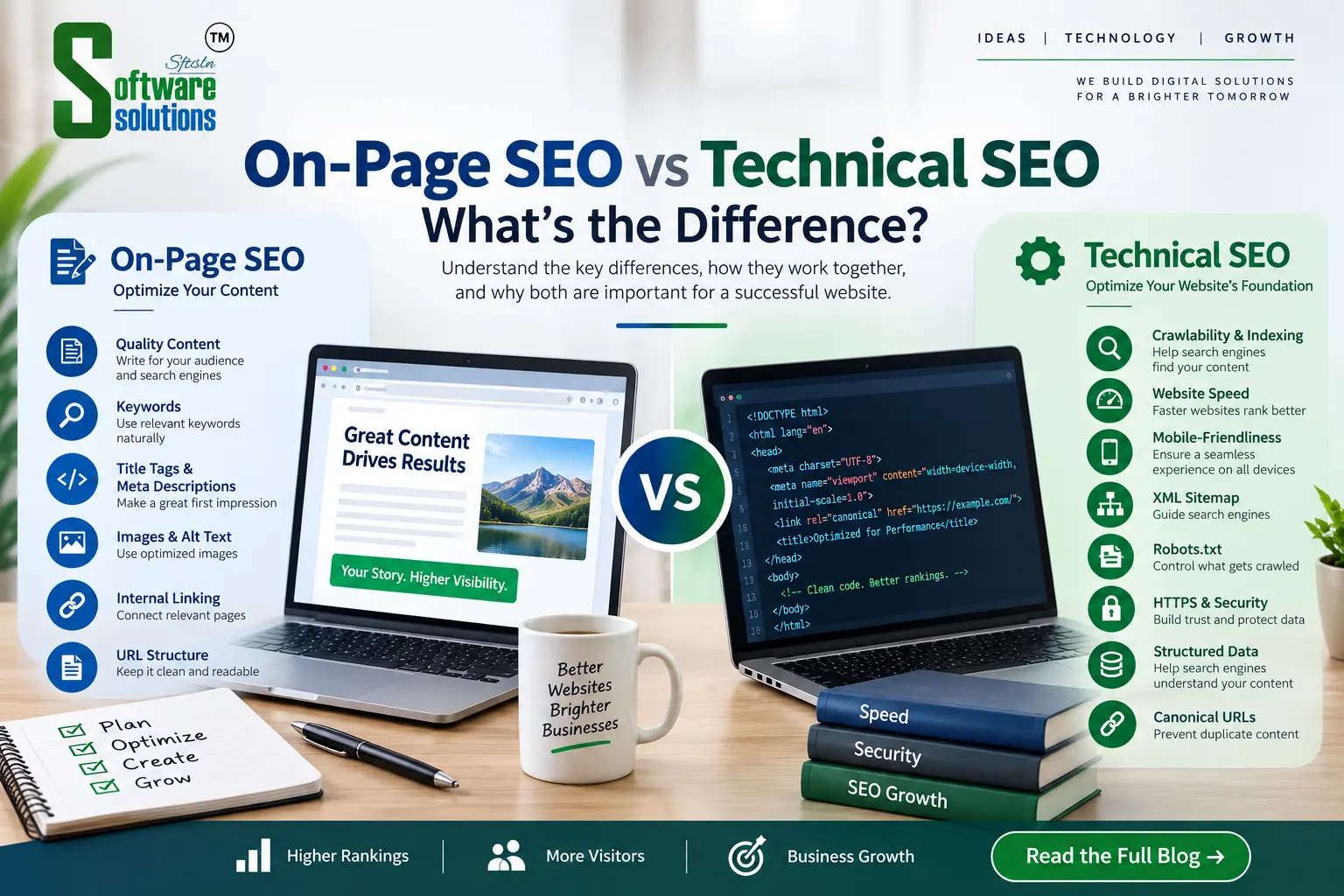
Here's the simplest way to think about it: technical SEO is about whether a search engine can even properly find, access, and understand your website in the first place. On-page SEO is about whether, once it's found, the content on that page is actually good enough to deserve ranking well. You genuinely need both. Our client's problem was a technical one hiding behind genuinely strong on-page work — and until that got sorted, none of the good writing mattered much.
What On-Page SEO Actually Covers
On-page SEO is what most people picture first when they hear the word "SEO," probably because it's the most visible, hands-on part. It's everything on an individual page that you can directly write, structure, and edit.
That includes things like:
- Page titles and meta descriptions that actually describe what the page is about, rather than something generic or copy-pasted across every page
- Headers used the way they're meant to be used — organizing content logically, not just made bold and big for visual effect
- Keywords worked in naturally, where they genuinely fit the topic, rather than repeated mechanically until a sentence stops reading like something a person would say
- Content that's actually useful — specific, well-organized, genuinely answering what someone searching that topic wants to know
- Internal links connecting related pages on your own site, so both visitors and search engines can follow the relationships between your content
- Images with proper alt text, and file sizes that don't slow the page down
- Clean, sensible URLs, rather than a string of random characters and numbers
The nice thing about on-page SEO is that it's entirely within your control. No developer or hosting provider needs to get involved — it's writing, structuring, and presenting your content properly.
What Technical SEO Actually Covers
Technical SEO lives somewhere most business owners never think to look, because it's largely invisible from the front end of a website. It's concerned with how well the site works, mechanically, from a search engine's point of view — separate entirely from how good the actual content is.
This is where things like site speed, mobile-friendliness, crawlability, site structure, HTTPS security, sitemaps, and structured data all live. None of it is something a visitor consciously notices when it's working correctly — they just experience a site that loads quickly, works properly on their phone, and feels trustworthy. They only notice when it's broken: a page that takes forever to load, or looks strange squeezed onto a small screen.
From a search engine's side, though, this layer matters enormously. If a search engine's crawler can't properly access a page — because of a blocked setting, a broken link structure, or a technical error — it genuinely doesn't matter how good the writing on that page is. The crawler may never fully process it in the first place.
So Which One Actually Matters More?
Honestly, this is the wrong question, even though it's the one we get asked most often. Neither one wins in isolation, because a serious weakness in either one puts a real ceiling on what the other can achieve.
Think of technical SEO as the plumbing and foundation of a house, and on-page SEO as the interior — the part people actually walk through and experience. A house with a stunning interior built on a cracked foundation is still a house with a serious, underlying problem. And a rock-solid foundation with nothing furnished inside isn't exactly appealing to visit either. Our client's situation earlier was basically a beautifully furnished house that nobody could actually get the front door open to see.
The honest, if slightly unsatisfying, answer is that a healthy website needs both, and neglecting either one badly tends to drag the other's results down with it.
How They Actually Work Together
In practice, technical SEO does the job of getting a page in front of a search engine in a form it can properly read and trust. On-page SEO is what convinces that search engine — and more importantly, the actual human reading it — that the page is genuinely worth ranking and worth reading.
If we're being practical about where to start: fixing technical issues generally comes first, or at least happens alongside content work, because there's limited value in polishing beautiful content sitting on pages a search engine is struggling to access properly. It's the digital equivalent of renovating a room nobody can get into yet.
A Simple Way to Check Both
On the on-page side, worth checking:
- Does every important page have its own specific, accurate title and description, rather than a generic repeated one?
- Are headers actually organizing the content logically?
- Is the content genuinely useful, or does it feel thin and generic?
- Do images have proper alt text?
- Are related pages linked to each other naturally?
On the technical side, worth checking:
- Do pages load quickly, especially on a phone?
- Does the site actually work well on mobile, not just technically "fit" on a small screen?
- Is the site secured with HTTPS?
- Are any important pages accidentally blocked from being crawled?
- Is there a working sitemap search engines can actually use?
- Are there broken links or messy redirect chains nobody's cleaned up?
Running through both lists honestly tends to reveal, fairly quickly, which side of the equation actually needs attention first.
If Your Content Is Good but Rankings Still Aren't Happening
This is almost always worth a technical check first. It's the exact situation our client was in — strong writing, real effort put into the content, and still nowhere to be found on Google. More often than people expect, the actual blocker isn't the writing at all. It's something quieter and more mechanical sitting underneath it.
If Your Site Is Technically Solid but Traffic Still Isn't Coming
This usually points the other way — toward content that isn't specific or useful enough for what people are actually searching for. A technically flawless site with vague, generic, or thin content doesn't give search engines much reason to rank it well, no matter how fast it loads.
Why Bothering to Understand the Difference Actually Helps
This distinction isn't just a technical curiosity — it genuinely changes how you'd go about diagnosing a website that isn't performing the way it should. Without understanding the difference, "our website isn't working" becomes a vague, hard-to-fix complaint. With it, the question becomes much sharper: is this a content problem, or a technical one? And that's a question you can actually investigate and act on.
We help businesses properly audit and fix both sides of this — the technical foundation and the on-page content — as part of our broader performance marketing services. If you're not sure which side is actually holding your website back, that's a genuinely reasonable thing to have looked at properly rather than guess at. Get in touch with Software Solutions and we'll walk through it together.
Frequently Asked Questions
What is the difference between on-page SEO and technical SEO? On-page SEO is about the content and structure of individual pages. Technical SEO is about whether the underlying site actually lets search engines access, crawl, and understand that content properly in the first place.
On-page SEO vs technical SEO — which is more important? Neither, really. A serious problem in either one limits how well the other can perform, so a healthy website needs both to be in reasonably good shape.
How do on-page SEO and technical SEO work together? Technical SEO gets a page in front of search engines in a form they can properly process. On-page SEO is what makes that page actually worth ranking once it's been found.
How can I improve my website's on-page SEO? Start with an honest look at your existing pages — are titles and descriptions specific and accurate, is the content genuinely useful, are headers used logically, are related pages linked to each other sensibly?
How can I improve my website's technical SEO? A proper technical review — checking speed, mobile experience, crawlability, and indexing — tends to surface issues you'd never notice just from browsing your own site normally.
Do small business websites need both on-page and technical SEO? Yes. Technical issues can quietly hold back even a small site, and thin, generic content limits how well even a technically flawless site can actually perform.