
Most businesses invest in search engine optimization for a simple reason: they want to be found by people who are already searching for what they offer. A restaurant in Salt Lake wants to appear when someone searches for a banquet hall. An accounting firm in Park Street wants to be seen by owners looking for GST help. An online store wants shoppers to land on its product pages instead of a competitor's.
But here is the catch. Ranking number one for a keyword does not automatically put money in your account. A page can rank well for a term nobody buys on, attract visitors who never contact you, or bring traffic from outside the area you serve. When a business judges SEO only by a keyword position report, it can feel successful on paper while the phone stays quiet.
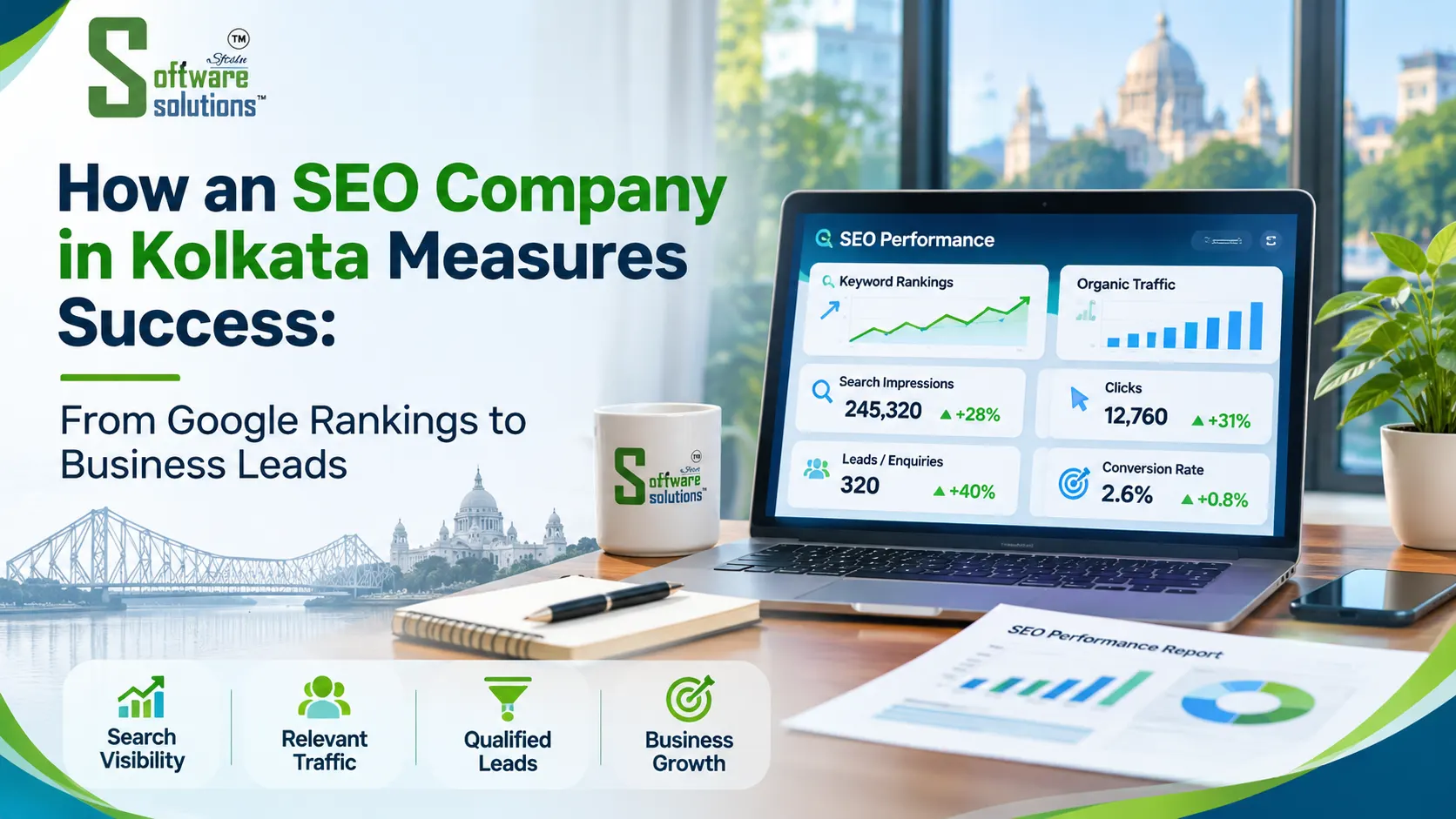
Effective SEO is measured across a chain: search visibility, organic traffic, user engagement, qualified enquiries and, finally, conversions and business outcomes. A professional SEO company in Kolkata should plan, implement and measure campaigns across that whole chain, not just the first link. This guide explains how that measurement works, which metrics matter, and how you can judge whether your own SEO is moving in the right direction.
Why SEO Success Is About More Than Google Rankings
Keyword rankings are useful, but they are a starting point. They tell you where a page appears for a particular search. They do not tell you whether anyone clicked, whether the visitor was a good fit, or whether they became a customer.
A more complete view looks at these layers:
- Search visibility: how often your website appears for relevant searches.
- Organic impressions: the number of times your pages were shown in results.
- Website clicks: how many people actually chose your result.
- Relevant visitors: people who match the kind of customer you want.
- Customer engagement: what those visitors do once they arrive.
- Lead generation: calls, forms, messages and quote requests.
- Conversion opportunities: the points on your site where a visitor can take the next step.
- Business return on investment: whether the revenue gained justifies the effort and cost.
A website with visitors versus a website with potential customers
These are not the same thing. Imagine a Kolkata-based interior designer who publishes a popular article on "free bedroom design ideas." It might draw thousands of visits from students and hobbyists across the country. Meanwhile, the page describing the designer's home renovation service in Kolkata gets a small number of visits but produces most of the enquiries. If you only counted visitors, the first page looks like the winner. If you count potential customers, the second page is doing the real work.
Here is another local example. A dental clinic in Behala might rank well for a general term like "dental care tips," but what it really needs is visibility for searches like "dentist near me" or "root canal treatment in Behala." Those searches come from people ready to book. Good SEO measurement separates the two kinds of traffic so you know which one is growing.
How an SEO Company in Kolkata Evaluates Website Performance
A proper performance review looks at several areas together, because a weakness in one can hold back the others.
- Website technical health. Page speed, mobile usability, secure connections, crawl errors, broken links and site structure. If search engines or users struggle with your site, nothing else works as well as it should.
- Search engine indexing. Whether your important pages are actually included in Google's index, and whether pages that should not appear (such as duplicate or thin pages) are being handled correctly.
- Keyword performance. Which search terms your pages appear for, and whether those terms match what your customers search for.
- Organic traffic. The volume, trend and quality of visits that come from unpaid search results.
- Content performance. Which pages and articles attract visitors, hold attention and lead people towards enquiries.
- Local search visibility. How you appear in map results and location-based searches, which matters greatly for businesses serving a specific area.
- Enquiry generation. The number and type of calls, messages and form submissions arriving from organic search.
- Conversion performance. How effectively visitors turn into enquiries, and enquiries into customers.
No single number tells the whole story. Rankings might improve while clicks stay flat, which suggests the page title and description need work. Traffic might rise while enquiries fall, which suggests the wrong audience is arriving or the page is failing to persuade. Reading the indicators together is what turns raw data into useful decisions.
Seven Important SEO Metrics Every Business Should Track
Keyword Rankings and Search Visibility
Rankings show how your pages perform for chosen primary and secondary keywords, such as the main service you sell and its closest variations. They are worth tracking, but they need to be read with care.
- Rankings fluctuate. Small day-to-day movements are normal as Google tests and updates results.
- Results differ by location, device and context. Someone searching in Kolkata may see different results from someone in Delhi, and mobile results can differ from desktop. Personalised factors such as search history also play a part.
- Search intent matters. A keyword may be popular but attract people looking for information rather than a service. Ranking for it may bring visits without enquiries.
- Competitor visibility gives context. Knowing which competitors appear for your target searches helps you judge whether a ranking change is a real gain or part of a wider shift.
Because of these variables, no honest agency can promise a fixed ranking. What a good report shows is the direction of travel across a meaningful set of keywords, not a single magic position.
Organic Search Impressions and Clicks
Google Search Console is a free tool that shows how your website performs in Google Search. It helps you understand:
- Total impressions: how many times your pages appeared in results.
- Total clicks: how many times people clicked through to your site.
- Average CTR (click-through rate): clicks divided by impressions.
- Average position: the typical ranking of your pages for the searches they appeared in.
- Search queries: the actual words people typed.
- Individual page performance: which pages earn visibility and clicks.
An impression is not a visit. It only means your result was displayed. A page can have thousands of impressions and very few clicks if its title or description does not match what searchers want. Watching impressions and clicks together tells you whether you are being seen, and whether being seen is leading to action.
Organic Website Traffic
Google Analytics shows what happens after the click. It helps monitor:
- Organic search traffic as a distinct channel.
- Landing page performance, meaning where visitors first arrive.
- New and returning users.
- Traffic trends over time.
- Traffic sources, so you can see how organic compares with direct, social, referral and paid visits.
More traffic is not automatically better. A local business that receives a surge of visitors from far outside its service area has not gained customers. Relevant traffic, from people who need what you offer and can actually buy it, is far more valuable than a large but unfocused visitor count.
Website Engagement and User Behaviour
Once visitors land, what do they do? Engagement signals help answer that:
- Which landing pages hold attention and which lose people quickly.
- Whether visitors move to other pages through navigation and internal links.
- How many reach the contact page.
- Which calls to action (CTAs) get clicked.
- How many start filling a form, even if they do not finish.
- Whether the site is easy to use on a phone, where many local searches happen.
This matters because SEO can only bring people to your door. If the website is slow, confusing, hard to read on mobile or unclear about what to do next, visitors leave and the SEO effort is wasted. Sometimes the best improvement to a campaign is fixing the experience that visitors meet after they arrive.
Qualified Leads and Enquiries
This is where SEO starts to connect with the business. Businesses can track:
- Enquiry form submissions.
- Phone enquiries, using call tracking where appropriate.
- WhatsApp enquiries.
- Consultation requests.
- Quotation requests.
- Qualified sales opportunities.
There is an important distinction here. A website interaction is something a visitor does, such as clicking a phone number or opening a form. A confirmed business lead is an enquiry from a real prospect who fits what you sell and could realistically become a customer. A form filled out by a job seeker, a spam message or a wrong number is an interaction, but not a lead. Reviewing enquiries with the business owner or sales team is the only reliable way to separate the two.
Conversion Rate and SEO ROI
The organic conversion rate is the share of organic visitors who complete a valuable action, such as submitting an enquiry. To think about SEO return on investment, businesses consider:
- The cost of SEO activities.
- The value of qualified leads.
- How many leads become customers.
- How much revenue can be attributed to organic search.
In theory, return on investment compares what you earned against what you spent. In practice, it is rarely a simple sum. Customers often find a business through several touchpoints: a search, a Google Business Profile visit, a recommendation, a phone call. Phone and offline sales may not be tracked back to their source, and the sales cycle for some services can run for months. When attribution data is incomplete, an honest ROI estimate should be presented as an informed approximation, not a precise figure. A good SEO partner explains these limits rather than hiding them.
Local Search and Google Business Profile Performance
For businesses serving customers in and around Kolkata, local visibility often drives enquiries as directly as the website itself. Your Google Business Profile can show:
- How often your profile appears in search and maps.
- The search queries that triggered it.
- Profile views.
- Website clicks.
- Call-button clicks.
- Direction requests.
- Customer reviews and ratings.
Reviews, accurate business details and relevant categories all support local relevance. Still, these actions are signals of interest, not confirmed leads. Someone who taps "call" may hang up before the phone rings, and someone who requests directions may never arrive. Treat these numbers as useful indicators and confirm real enquiries through your own records.
What Should Businesses Expect from Professional SEO Services in Kolkata?
A professional engagement should be transparent about what is being done and why. It typically includes:
- An initial SEO audit to understand where the website stands today.
- Keyword research based on what your customers actually search for.
- Competitor analysis to see who you are up against and where gaps exist.
- Technical SEO to make the site fast, crawlable and error-free.
- On-page optimization of titles, headings, content and internal links.
- A content strategy that supports both commercial and informational searches.
- Local SEO for map visibility and area-based searches.
- Link acquisition and authority development through ethical, relevant means.
- Performance monitoring against agreed measures.
- Periodic reporting in plain language that links activity to results.
Every business is different. A neighbourhood clinic, a manufacturer selling across India and an online store face very different competition, so the strategy should be adapted to your goals and industry rather than copied from a template. Be cautious of anyone promising guaranteed rankings or instant traffic growth. Search engines do not allow anyone to guarantee positions, and sustainable results take consistent work.
How an SEO Agency in Kolkata Builds an SEO Strategy
A practical workflow often follows these steps:
- Understand business goals and target customers. Who do you want to reach, where, and what counts as a valuable enquiry?
- Perform a website SEO audit. Identify technical, content and structural issues.
- Identify relevant keywords. Both commercial terms (people ready to buy) and informational ones (people researching).
- Analyse competitors. Learn what is working for others in your market.
- Prepare a keyword-to-page mapping strategy. Assign each target keyword to the most suitable page, and flag where new pages are needed.
- Improve technical and on-page SEO. Fix issues and refine the pages that matter most.
- Develop useful supporting content. Answer the questions your customers ask.
- Strengthen local search presence. Optimise the Business Profile, citations and local signals.
- Monitor performance and qualified enquiries. Track the metrics covered above.
- Refine the strategy using actual data. Double down on what works and adjust what does not.
The last two steps feed back into the first. What the data reveals about customers and search behaviour shapes the next round of planning, which is why SEO is better understood as a continuous cycle than a one-time project.
How Long Does SEO Take to Show Results?
There is no honest universal answer, because the timeline depends on the starting point and the market. Factors include:
- Website age and history. Newer sites usually need time to build trust.
- Existing organic visibility. A site with some visibility may move faster than one starting from nothing.
- Technical condition. Serious issues may need fixing before gains appear.
- Competition. Crowded industries take longer than niche ones.
- Content quality. Helpful, well-targeted pages perform better over time.
- Backlink profile. The quality and relevance of sites linking to you.
- Search intent. Matching what searchers actually want to find.
- Website improvements. How quickly recommended changes are implemented.
- Local market conditions. Competition and demand within your city or area.
SEO is a long-term process, and results vary between websites and industries. Early progress is often visible first in impressions and indexing, then in clicks and traffic, and later in enquiries. Any provider who promises a specific ranking by a specific date is making a claim they cannot control.
Common SEO Reporting Mistakes Businesses Should Avoid
- Focusing only on keyword positions. Rankings without clicks or enquiries can be misleading.
- Ignoring organic conversion rates. Traffic that never converts is a signal worth investigating.
- Reporting traffic without checking relevance. Visitors from the wrong audience or region inflate numbers without adding value.
- Ignoring branded versus non-branded searches. People searching your company name already know you. Growth in non-branded searches shows you are reaching new customers.
- Ignoring landing page performance. Some pages carry most of the results and deserve attention.
- Treating every click as a lead. Interactions are not the same as qualified enquiries.
- Using very small data samples. A handful of visits or enquiries can swing wildly and should not drive major decisions.
- Ignoring Google Business Profile performance. For local businesses, this is often a major source of enquiries.
- Failing to compare equivalent periods. Comparing a festive month with a quiet one, or a week with a month, produces false conclusions. Compare like with like, ideally year on year for seasonal businesses.
Accurate reporting gives you a clear picture of what is working. That lets you spend your budget on the activities that actually support your business goals.
How Software Solutions Approaches SEO Services in Kolkata
Software Solutions is a Kolkata-based company that treats SEO as a measurable part of a business's wider digital presence. Its approach is to align search activity with your business objectives and with the intent behind the searches your customers make, rather than chasing rankings for their own sake.
The SEO capabilities covered include:
- SEO audits
- Keyword research
- Technical SEO
- On-page SEO
- Local SEO
- Google Business Profile optimization
- SEO content strategy
- Competitor analysis
- Ethical link building
- Performance monitoring and reporting
The emphasis is on practical, transparent work: understanding what your business sells, who you want to reach, and how search visibility can support enquiries. You can read more about the process on the SEO services page.
Frequently Asked Questions About SEO Services in Kolkata
1. What does an SEO company in Kolkata do?
An SEO company helps your website become easier for search engines to understand and easier for customers to find. This usually involves auditing the site, researching keywords, fixing technical issues, improving page content, building local visibility, earning relevant links, and tracking performance through reports.
2. How do SEO services in Kolkata help local businesses?
They help businesses appear when nearby customers search for relevant products or services. Local SEO, including an optimised Google Business Profile, accurate contact details and good reviews, can improve visibility in map results and location-based searches, which may lead to more calls, visits and enquiries.
3. How can I evaluate an SEO agency in Kolkata?
Look for clear explanations of the work they will do, realistic expectations, and reporting that goes beyond keyword positions. Ask how they track enquiries, how often they report, and how they adapt strategy to your industry. Be wary of guaranteed rankings, vague deliverables or unwillingness to share what is being done.
4. How long does SEO take to generate organic enquiries?
It varies. Website age, competition, technical condition and content quality all play a role. Many businesses see early signs such as improved indexing and impressions before they see steady enquiries. Because results differ between sites and industries, no one can promise an exact timeline.
5. Which SEO metrics should businesses monitor?
Key metrics include keyword visibility, impressions, clicks, click-through rate, organic traffic, engagement on landing pages, qualified enquiries, organic conversion rate and Google Business Profile actions. Reviewing them together gives a more reliable picture than any single number.
6. What is the difference between organic traffic and qualified leads?
Organic traffic is the number of visitors arriving from unpaid search results. A qualified lead is an enquiry from a genuine prospect who fits what you offer and could realistically become a customer. A website can have plenty of traffic and very few qualified leads if the audience is not the right one.
7. How important is Google Business Profile for local SEO?
For businesses serving a local area, it is very important. It influences how you appear in map results and local searches, and it gives customers quick access to your phone number, directions, hours and reviews. Keeping it accurate and active supports local visibility, though profile actions should not be mistaken for confirmed leads.
8. How can businesses measure the return on SEO investment?
Compare the cost of SEO activities with the value of qualified leads and the revenue they produce, using tracking for forms, calls and messages, along with your own sales records. Attribution is often incomplete, especially for phone and offline sales, so ROI should be treated as a reasoned estimate rather than an exact calculation.
Final Thoughts
SEO success cannot be summed up by a keyword position. It is better understood as a combination of search visibility, relevant traffic, meaningful engagement, qualified leads and, ultimately, business outcomes. Rankings are one useful signal along the way, but the real question is whether more of the right people are finding you and getting in touch.
If you are paying for SEO, ask for reporting that follows the whole journey from impression to enquiry, and judge the campaign by that evidence. Meaningful data leads to better decisions than a ranking report alone ever could.
Looking to improve your website's search performance and turn visibility into real enquiries? Get in touch with the team at Software Solutions to discuss your goals and see how a measurable SEO strategy could support your business.