Two quotations for what sounds like the same software can look very different on paper. One is a fraction of the other's price. One promises delivery in eight weeks, the other in fourteen. One lists a dozen features, the other three lines. It's tempting to assume the cheaper, faster one is simply better value.
Often it isn't. The two documents may be describing different projects, and the real differences sit in what's left unsaid: who tests the software, who hosts it, what happens when you ask for a change, who owns the code. A polished layout doesn't prove a project is well defined, and the lowest quote isn't automatically the most economical once the missing pieces are added back.
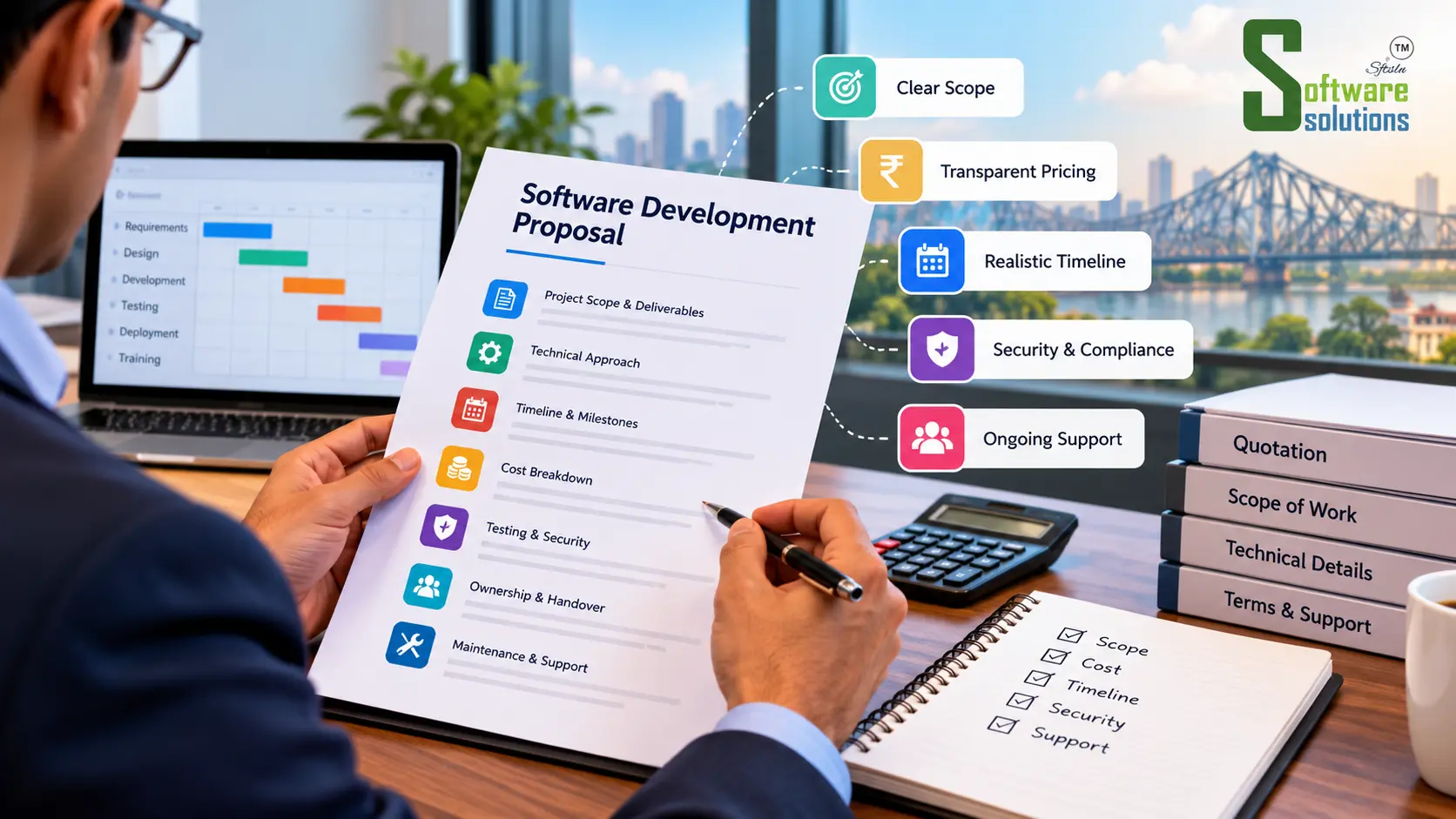
A software development proposal is the document where a company's assumptions become visible, if you know how to read it. This guide walks through what to check, in the order a business owner would typically meet it, whether you're comparing offers from software development companies in Kolkata or anywhere else.
1. Start With the Business Problem and Project Objectives
A good proposal reflects your problem, not just a list of features you happened to mention. Look for a clear statement of what the software is meant to solve, who will use it, how work flows through it, and how you'll know it succeeded.
Take a distributor commissioning inventory software. A strong proposal would say the problem is stock records that don't match the warehouse. It would name the users (warehouse staff, sales, accounts), describe the workflows (goods receipt, sales orders, returns), separate must-have features from later enhancements, and name the systems it has to connect to, such as existing accounting software. It would also define success in terms you can check, such as physical counts matching system records within a tolerance you've agreed.
A service business improving lead management would get a similar treatment, with the focus on how enquiries are captured, assigned, and followed up.
If the proposal jumps straight to modules and prices without restating your problem, the company may not have understood it.
2. Check the Project Scope and Deliverables
The scope is the heart of the document. A clear software project scope names what will be built and delivered, including:
- Modules and features, listed individually
- User roles and permissions
- Reports and dashboards
- Third-party integrations
- Data migration from existing systems
- UI/UX design
- Testing and deployment
- Documentation and training
- Explicit exclusions, meaning what isn't included
Phrases like "complete business management system" mean very little without a feature list behind them. Each of those words could stretch or shrink the project by weeks.
Here's a practical way to find gaps. Walk through a typical day in your business and look for each step in the proposal. Where do orders get entered? Where do reports come from? Who migrates last year's data? Anything you can't find is either missing, or assumed to be extra. Ask which, and get the answer in writing, because software development deliverables that aren't written down tend to be disputed later.
3. Understand the Technical Approach
You don't need to read code, but you should understand the broad choices.
- Technologies: ask why they suit your project. The best choice depends on your requirements, not on whichever framework is fashionable. Common, well-supported technologies are easier to maintain and to hand to another team later.
- Hosting and infrastructure: where will it run, who pays, and how will it cope with growth?
- Architecture: at a high level, how do the application, database, and integrations fit together? Is there a separate testing environment before changes reach your live system?
- Security and access controls: how are logins, roles, and data protected?
- Maintainability and documentation: could another developer pick this up?
- Future development: will adding a module later mean rebuilding what exists?
A company that can't explain these choices in plain language is worth questioning.
4. Review the Timeline and Project Milestones
A single delivery date isn't a plan. A credible software development timeline breaks the work into stages: requirement confirmation, design and approval, development milestones, testing and user acceptance, deployment, and training and handover.
It should also show what depends on you, such as approving designs, supplying data, and giving feedback. Delays on either side move the dates, so ask how delays, dependencies, and changes will be handled.
Be careful with an unusually short timeline promised before anyone has fully understood your requirements. Speed gained by skipping testing or design review tends to return later as defects or scope disputes.
5. Examine Testing, Security, and Data Protection
The proposal should say how quality will be checked. Look for functional and integration testing, user acceptance testing where your staff try the system with realistic data, and a clear way to report and resolve bugs.
On security and operations, look for how backups and recovery are handled, how access permissions work, how updates are deployed safely, and who is responsible for each of these after launch.
If the system will store personal data, ask how it will be handled in line with applicable Indian law, including the Digital Personal Data Protection Act, 2023. This is general information, not legal advice. No single technical measure guarantees compliance, so check your obligations with a legal advisor.
6. Clarify Ownership, Source Code, and Handover
This is easy to overlook until a relationship ends. Settle these points before signing:
- Who owns the custom-developed deliverables
- Whether you receive the source code, and when
- Intellectual property terms
- Third-party and open-source components, and their licences
- Documentation
- Hosting and administrator credentials
- How you can export and transfer your data
- What access you keep if the relationship ends
Don't assume that paying for software means owning it. Rights depend on what the written agreement says, and without a written assignment you shouldn't take ownership of the code for granted. Obtain legal advice where needed.
7. Review Maintenance and Post-Launch Support
Software needs care after it goes live. A good proposal states:
- A warranty or defect-fix period, and what counts as a defect
- Whether ongoing maintenance is offered, and at what cost
- Who applies security patches and dependency updates
- The line between bug fixes and new features
- Support channels and response expectations
- Who is responsible for hosting
- How future enhancements will be scoped and priced
Ask for written confirmation of what's included in support and what isn't, so you can budget for the recurring costs.
8. Compare Multiple Proposals Using the Same Checklist
When you're reviewing two or three proposals, score each against the same list:
| Evaluation criterion | What to verify |
|---|---|
| Business requirements | Does the proposal address the actual problem? |
| Project scope | Are features, exclusions, and deliverables documented? |
| Technical approach | Is the solution suitable and maintainable? |
| Pricing | Are included and excluded costs transparent? |
| Timeline | Are milestones and dependencies explained? |
| Testing | Are testing and acceptance criteria defined? |
| Security | Are data protection responsibilities documented? |
| Ownership | Are source code and handover terms clear? |
| Support | Are maintenance and support costs specified? |
| Change management | Is there a documented process for scope changes? |
Treat this as a decision aid, not a substitute for reading the contract. A proposal is usually an offer, and the signed agreement is what binds you, so check that its terms carry over.
9. Warning Signs in a Software Development Proposal
Some patterns deserve a closer look:
- Vague scope and deliverables
- A price with no explanation of what it includes
- Guaranteed delivery dates before requirements are understood
- No testing or acceptance criteria
- Unclear source-code ownership
- No provision for maintenance or security updates
- Unspecified third-party costs
- No written process for handling changes
- Pressure to approve without time for review
Keep perspective. One missing detail doesn't prove a company is unreliable. It means you should ask for clarification. How willingly and clearly they respond tells you a lot.
Approve the Proposal Only When the Details Are Clear
The best proposal isn't the cheapest or the fastest. It's the one where scope, total cost, timeline, technical approach, ownership, and support are clear enough that both sides know what they've agreed to. Ask questions, and get answers in writing before committing.
If you'd like to talk through a proposal you've received, or describe what you need, you're welcome to contact Software Solutions and discuss your current business problem, the features you need, your existing systems, and your budget and timeline. We can also help you work out whether custom software or a ready-made product makes more sense, since not every business needs a custom build.