A few months ago, the owner of a mid-sized distribution company watched a demo where someone typed a paragraph into an AI tool and got a working order-tracking page in minutes. The screen looked polished. The buttons worked. Her first thought was a reasonable one: if software can be produced this quickly, why pay a development team?
It’s a question many business owners and founders are asking right now, usually in the form of “will AI replace software developers?” The honest answer is more useful than a simple yes or no. AI is changing how software gets built, and some of that change is significant. But generating code is only one slice of delivering software a business can rely on every day.
What AI Can Already Do in Software Development
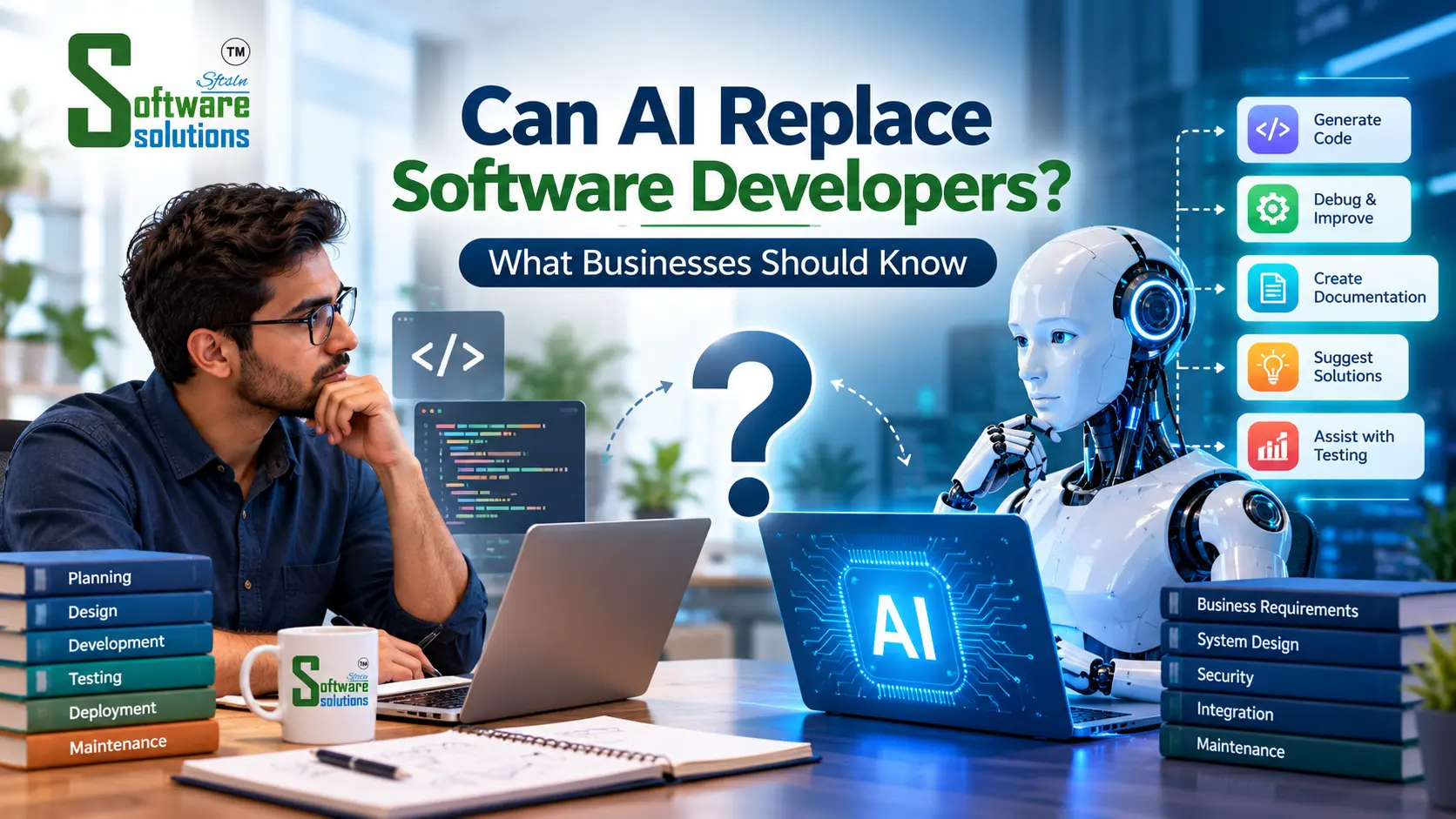
Modern AI software development tools are genuinely capable, and it would be unfair to pretend otherwise. Used well, they can write routine functions, suggest fixes when something breaks, and explain what an unfamiliar block of code is doing. They can draft documentation, propose test cases, and help a developer explore two or three ways of solving the same problem before committing to one.
They are also useful for prototypes. If you want to see a rough version of a booking form or a dashboard before investing in a full build, AI-assisted coding can get you there faster than it used to.
The results, though, depend heavily on the task, the tool, and the quality of the instructions. Ask for a simple contact form and you’ll probably get something usable. Ask for a billing module that handles part-payments, tax rules, and refunds across three regions, and the output will need careful checking. The tool can’t know what it hasn’t been told, and it won’t always tell you what it’s guessing.
Can AI Build an Entire Business Application on Its Own?
This is where the gap between a demo and a dependable product becomes clear.
A demo has to work once, in ideal conditions, in front of an audience. A business application has to work every day, with messy data, impatient users, and situations nobody planned for. What happens when two staff members edit the same record at the same time? What if a customer uploads a file in an unexpected format? What if the payment gateway times out halfway through a transaction?
Beyond edge cases, real business software has to deal with a long list of practical concerns:
- Understanding what the business actually needs, which is often different from what was first requested
- Connecting with existing systems such as accounting software, inventory tools, or a CRM
- Managing who can see and change which information
- Protecting customer and financial data
- Testing thoroughly before real users depend on it
- Keeping the software working as requirements, browsers, and security standards change
None of this means AI can’t contribute to a complete application. It can, and increasingly does. The point is that each of these areas needs human review and technical oversight, because mistakes in them are expensive and sometimes hard to spot until something goes wrong.
Where Human Software Developers Still Matter
Much of what a good developer does never shows up as lines of code.
It starts with listening. A business might say, “We need a customer portal,” when the real problem is that the support team spends half its day answering “where is my order?” emails. A developer who understands the problem may suggest something smaller, cheaper, or different from what was asked for. An AI tool, by default, builds what you describe.
Then come the decisions that shape everything afterward: how the system is structured, which technologies to use, and where to accept trade-offs between speed, security, and cost. A fast solution that’s hard to extend can become a burden within a year. A highly secure design might be overkill for an internal tool used by five people. These calls depend on context that rarely fits into a prompt.
Developers also review code, including AI-generated code. Code can look correct and still contain a subtle flaw, such as a missing permission check or a calculation that fails on the last day of the month. Spotting these requires someone who understands both the code and the business rule behind it.
And once the software goes live, the work continues: deployment, troubleshooting, updates, and support when something unexpected happens at 9 a.m. on a busy Monday. Many developers now use AI tools to do all of this more efficiently, which is part of the picture too.
AI vs. Software Developers: What Is the Difference?
It’s tempting to frame this as a contest, but in practice the two overlap more than they compete. The table below gives a rough, general view. Capabilities vary by tool and by project, and experienced developers use AI assistance themselves.
| Area | AI tools | Human developers |
|---|---|---|
| Routine code generation | Often quick and helpful for common, well-defined tasks | Can do it too, and decide when generated code is good enough |
| Business requirement analysis | Works from what it’s given; limited awareness of unstated needs | Can ask questions, challenge assumptions, and spot gaps |
| Complex system design | Can suggest options, but results need evaluation | Weigh trade-offs against the business’s goals and constraints |
| Security review | May miss vulnerabilities or introduce them | Can review, test, and apply security practices to the specific project |
| Testing | Can draft tests; coverage and relevance need checking | Decide what must be tested and verify real-world behavior |
| Long-term maintenance | Can help with fixes and documentation | Take responsibility for updates, support, and accountability |
The most realistic picture in many projects today is a developer working with AI tools, not a choice between one or the other.
Will AI Reduce Software Development Costs?
It may, for certain tasks. If AI-assisted coding helps a developer finish routine work faster or produce a prototype with less effort, that can reduce the time spent on those parts of a project.
But writing code is rarely the whole bill. Projects also involve planning, design, testing, security measures, integrations with other systems, infrastructure, deployment, and ongoing maintenance. AI tools may help with some of these, but they don’t make them disappear. Cutting corners on them tends to show up later as bugs, downtime, or a rebuild.
So whether you save money depends on the project: its size, its complexity, how clearly it’s defined, and how much risk the business can accept. Anyone promising a specific percentage in savings before understanding your requirements is guessing.
What This Means for Businesses Investing in Custom Software
If you’re planning a software project, the question worth asking is less “do they use AI?” and more “can they deliver something reliable that fits how my business works?”
When evaluating a development partner, a few things deserve attention:
- Understanding of your processes. Do they ask about how your team actually works, or jump straight to technology?
- Clear communication. You should know what’s being built, what it will cost, and what could change along the way.
- Code quality and testing. Ask how they review code, including AI-assisted code, and how they test before release.
- Data security. Ask how sensitive information is handled and who can access it.
- Integration experience. Software that can’t talk to your existing tools often creates more manual work, not less.
- Ongoing support. Software needs care after launch. Find out who will fix problems and how quickly.
The goal is software that solves a business problem and keeps working, not the cheapest or fastest generation of code. Businesses looking at custom software development services will generally get better results by judging providers on these points rather than on speed alone.
What Does the Future of Software Development Look Like?
Nobody can say with certainty, and it’s worth being wary of anyone who sounds too sure in either direction.
What can be said today is that AI-assisted coding is becoming a normal part of how many developers work. Routine tasks are getting faster, and developers are spending more of their time on design, review, and decision-making. That suggests the role is changing in emphasis more than disappearing.
What happens beyond that is speculation. AI tools will likely keep improving, and some tasks that need human attention today may need less of it later. Other tasks, especially those involving judgment, accountability, and understanding a particular business, may stay human-led for a long time. Planning around a single confident prediction is riskier than staying flexible and revisiting the question as the tools mature.
So, Will AI Replace Software Developers?
AI is changing how software is built and can automate parts of the process. But a working piece of code is different from a dependable business application, and the gap between them is where planning, review, testing, security, and long-term care come in. Before assuming AI can stand in for an experienced development team, it’s worth looking at the full requirements of your project, not just the part where code gets written.
If you’re weighing a software project, a practical next step is to write down what the software needs to do, what it needs to connect to, and what would happen if it failed. That list will make any conversation with a development partner more productive. And experienced software professionals can help you plan, build, test, and maintain custom applications that hold up in daily use, with AI as one of the tools in the process rather than a replacement for the process itself.