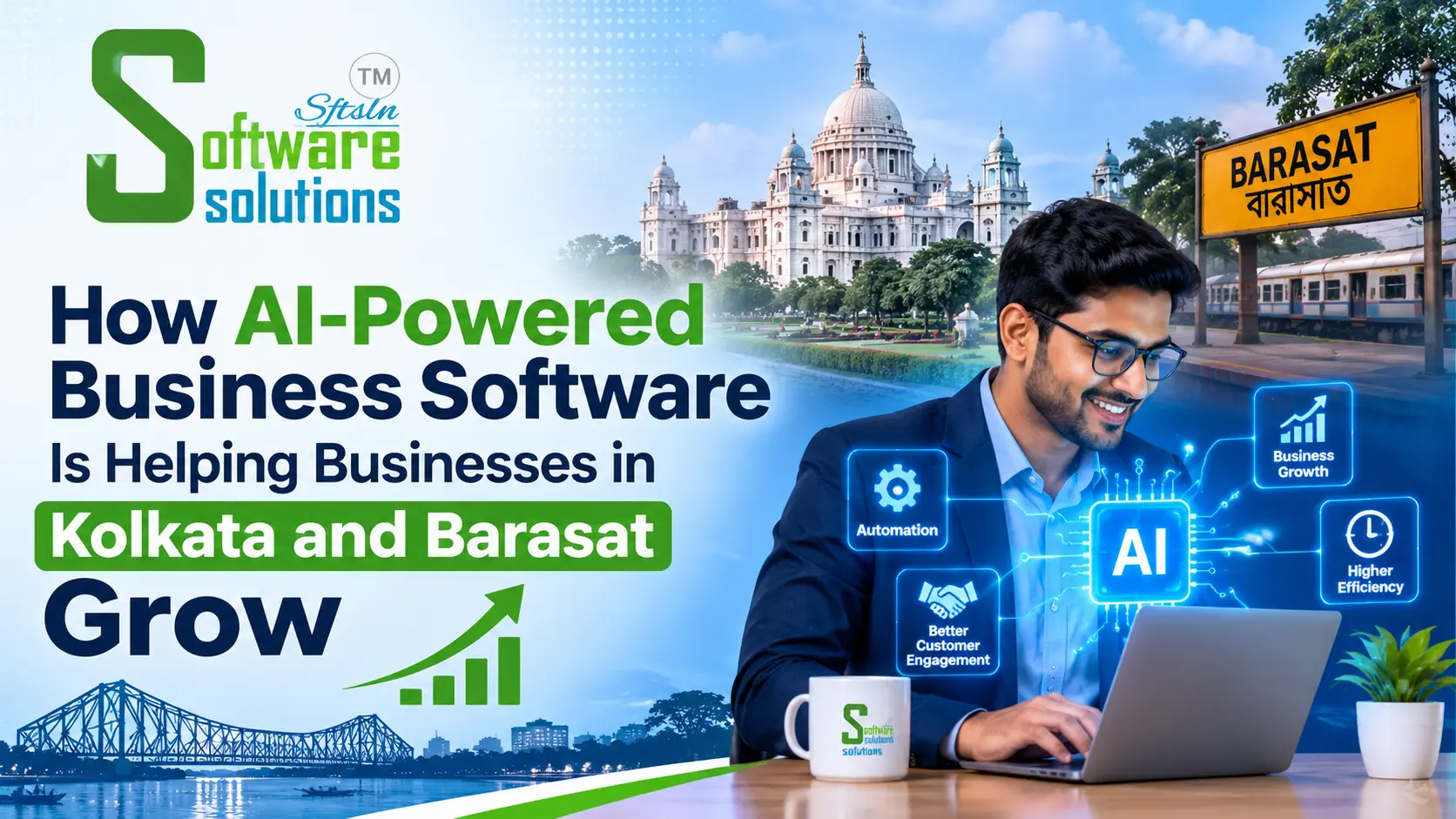
Most businesses in Kolkata and Barasat run on a mix of WhatsApp chats, Excel sheets, billing software and paper registers. Customer enquiries arrive on phone calls and messages. Sales are recorded in one place, stock in another, and employee tasks somewhere else. Reports get built by hand at month-end, usually after the decisions they were meant to inform.
AI-powered business software tries to reduce that friction. It adds capabilities such as understanding text, spotting patterns in sales data, extracting figures from documents and suggesting next steps to the tools a business already uses for customers, stock, billing and reporting. It doesn’t replace your team. It takes over repetitive work so people can spend their time on judgement and relationships.
This article looks at where AI-enabled software is practical for local businesses, where it isn’t, and how to decide what suits your operations. A good software company in Kolkata or Barasat should help you work that out before writing any code.
Why Businesses in Kolkata and Barasat Are Exploring AI-Powered Software
Local businesses face problems that will be familiar to most owners:
- Competition from larger and online players. Customers compare options quickly and expect fast replies.
- Higher customer expectations. People expect answers outside shop hours and quick follow-ups on quotations.
- Manual data entry. The same invoice or enquiry is often typed into two or three systems.
- Disconnected applications. Billing, CRM, inventory and accounts don’t share data, so nobody has the full picture.
- Large volumes of information. Years of sales records hold useful patterns that nobody has time to analyse.
- Slow reporting. Management reports take hours or days to assemble.
- Repetitive administration. Reminders, status updates and routine messages consume staff time.
AI and automation can help with several of these, but not all of them, and not for every business. A small shop with a handful of daily customers may be well served by simple billing software. AI earns its place where there is enough repeated work or enough data for it to add something.
7 Practical Ways AI-Powered Software Can Help Businesses
AI-Powered Customer Support and Chatbots
An AI-assisted chatbot can answer common questions about opening hours, services, product details or order status. It can collect enquiry details such as name, requirement and contact number, and ask a few qualifying questions so your team knows which leads are worth calling first. It also keeps working outside business hours, so an enquiry made at 10 p.m. doesn’t wait until morning with no acknowledgement.
Chatbots work best on predictable questions. Complaints, negotiations, unusual requests and anything emotionally sensitive need a person. A well-designed system hands the conversation to a human with the context already attached, rather than trapping customers in a loop.
Intelligent Lead Management and CRM Automation
Many businesses lose enquiries because nobody followed up. AI-assisted CRM software can sort incoming leads by source or type, flag the ones that look most promising, log every customer interaction in one place and send reminders when a follow-up is due. Pipeline views show where deals stall, and summaries of past conversations help a salesperson prepare for the next call.
The AI part is the sorting, prioritising and summarising. The fundamentals still matter: a clean customer record and a consistent follow-up routine. If you’re considering a CRM, clear workflows come first and AI features second.
AI-Assisted Inventory Management and Demand Forecasting
Inventory software can track stock movement, send low-stock alerts and show which items sell slowly. AI adds analysis of historical sales, such as seasonal patterns around Durga Puja, Eid, Poila Boishakh or wedding season, to suggest how much of each product you may need. That helps with purchase planning.
These are predictions, not guarantees. A forecast is only as good as the data behind it, and it can’t foresee a supplier delay, a price change or a sudden shift in demand. Treat it as a planning input that a person reviews.
AI-Powered Business Reporting and Analytics
Owners often have the data but not the time to read it. AI-assisted analytics can summarise sales trends in plain language, highlight unusual changes (a product whose sales dropped, a branch whose costs rose) and answer simple questions such as “which customers haven’t ordered in three months?” Managers get a clearer view without waiting for someone to build a spreadsheet.
The insights support decisions; they don’t make them. Someone who knows the business still needs to judge whether a pattern is meaningful.
Intelligent Document Processing and Data Extraction
Invoices, purchase orders, receipts and forms often arrive as PDFs or photos and get retyped by hand. AI-based document processing can read these and pull out fields such as dates, amounts, supplier names and item lines, then pass them to your accounting or inventory system.
Extraction isn’t perfect, particularly with poor scans or handwritten forms. Extracted data should be checked, and good systems flag low-confidence fields for review instead of silently accepting them. This matters most where figures feed into GST filings or payments.
AI-Assisted Workflow Automation
Many daily tasks follow rules: route an enquiry to the right person, classify an incoming request, assign a task, send a notification, update a record. AI helps where the input is messy, for example reading a free-text message and deciding which department should handle it. The software can then assign the task, notify the owner and keep teams coordinated without constant manual forwarding.
This is where custom software development often comes in, because the useful automations depend on how your particular business works.
AI-Powered Customer Behaviour Analysis
Transaction and interaction data can show which products customers ask about most, what they tend to buy together, how engagement changes over time, and which existing customers might be ready for another purchase. A restaurant might see which dishes drive repeat visits. A distributor might see which retailers are ordering less than before.
This involves personal data, so handle it carefully. Collect only what you need, be open with customers about how their information is used, restrict who can access it, and follow applicable Indian data protection requirements. Analysis should help you serve customers better, not intrude on them.
Which Businesses in Kolkata and Barasat Can Benefit from AI Software?
Retail and Wholesale Businesses
Retailers and wholesalers deal with large product ranges and fluctuating demand. AI-assisted inventory analysis can show slow-moving stock, sales insights can reveal best-selling lines, and customer management can track repeat buyers and send reminders when it’s time to reorder.
Manufacturing and Distribution Companies
Smaller manufacturers and distributors can use software for production reporting, raw material forecasting and visibility across dispatch and delivery. Even a simple dashboard that brings stock, orders and dispatch status together can reduce the back-and-forth between departments.
Healthcare and Clinics
Clinics and diagnostic centres can use software for appointment management, reminders, patient record organisation and processing of reports and forms. These tools assist administration only. AI is not a substitute for clinical judgement, and medical decisions stay with qualified professionals. Patient data also needs strong security.
Hospitality and Restaurants
Restaurants, banquet venues and hotels handle bookings, enquiries and daily operations at once. AI-assisted tools can answer common booking questions, capture enquiry details, and help with operational reporting such as peak hours, popular items and booking patterns.
Service-Based Businesses
Consultants, agencies, coaching centres and repair or installation services depend on lead handling and follow-up. CRM workflows, automated reminders and an assistant that captures enquiry details can help ensure that no enquiry is forgotten.
Custom AI Software vs Ready-Made AI Tools
There are three broad routes:
- Ready-made AI applications, subscription tools used largely as they come.
- AI features inside software you already use, such as a billing, CRM or accounting package that has added AI options.
- Custom AI-powered applications, built around your processes and connected to your own systems.
| Factor | Ready-Made AI Tools | Custom AI Software |
|---|---|---|
| Initial implementation | Usually faster | Requires planning and development |
| Customization | Depends on the product | Can match specific workflows |
| Integration | Depends on available connectors | Can be designed around existing systems |
| Scalability | Product-dependent | Can be planned around business requirements |
| Maintenance | Provider-dependent | Requires an agreed maintenance approach |
When existing tools make sense: your needs are common (basic chatbot, standard accounting, simple CRM), you want to start quickly, and a product already fits your workflow.
When custom development may be appropriate: your process is unusual, you need several systems to work together, ready-made tools force awkward workarounds, or you want control over how your data is handled. Even then, a phased approach starting with the most valuable feature is usually sensible. Custom software isn’t automatically the better choice, and an honest developer will tell you when an existing product is enough.
How to Choose the Right Software Development Company for AI-Based Solutions
Whether you’re looking for a software company in Kolkata, a software company in Barasat, or a software development company in Kolkata with AI experience, these are the questions worth asking:
- Do they understand your business? A good partner asks about your workflows before proposing technology.
- Is their software development experience relevant? Look for comparable work, not just AI buzzwords.
- Can they integrate AI sensibly? Ask which AI capabilities they would use, and why.
- How do they handle data security? Ask about access control, backups and how your data is stored.
- Can they connect to your existing systems? Integration with your billing, accounting or messaging tools often decides whether a project succeeds.
- Is there clear planning and documentation? You should receive written requirements and a defined scope.
- How do they test and implement? Testing with real data and staff training matter as much as development.
- What happens after launch? Ask what maintenance and support are available, and on what terms.
Be cautious of any provider that promises guaranteed results or fixed outcomes before understanding your requirements.
How Software Solutions Helps Businesses Explore AI-Based Software
Software Solutions, a software development company in Kolkata, is based in Barasat and works with businesses in both cities. As a software company in Barasat, it builds software for local businesses, and its work covers areas relevant to this article:
- AI tool development
- Custom software development
- CRM software development
- Business management software
- Business process automation
- API and application integration
A typical software project moves through these stages:
- Understanding business requirements: how your team works today and what’s slowing it down.
- Identifying suitable automation opportunities: deciding where automation helps and where it doesn’t.
- Planning the software architecture: how the system, data and integrations fit together.
- Selecting appropriate AI capabilities: choosing only the AI features that serve the goal.
- Developing and integrating the application: building it and connecting it to your existing tools.
- Testing and implementation: checking it with realistic data, then rolling it out with your team.
- Ongoing improvements and support: refining it as your business and data change.
The aim of the first conversation is to work out whether AI is the right answer at all.
Frequently Asked Questions
1. What is AI-powered business software?
It’s business software, such as a CRM, inventory system or reporting tool, that includes AI capabilities like understanding text, finding patterns in data, or extracting information from documents to automate or support routine work.
2. How can AI help small businesses in Kolkata?
It can speed up replies to customers, organise leads, flag low stock, summarise sales data and reduce manual data entry. The benefit depends on how much repeated work and data a business has.
3. Can AI automate customer management and sales?
It can automate parts of them, such as lead sorting, reminders and routine replies. Relationship building, negotiation and complex customer issues still need people.
4. Is custom AI software expensive?
Cost depends on scope, complexity and integrations, so there’s no single answer. Starting with one well-defined feature and expanding later is a common way to keep the investment manageable. A development company should be able to give an estimate once it understands your requirements.
5. Can AI be integrated into existing business software?
Often, yes. Depending on the system, AI features can be added through integrations or APIs. How easily depends on your current software and what it allows.
6. Which industries can benefit from AI-based software?
Retail, wholesale, manufacturing, distribution, clinics, restaurants and service businesses can all find uses, particularly where there are repetitive processes or useful data.
7. How do I choose a software company in Kolkata for AI development?
Look at their understanding of your business, relevant experience, data security practices, integration ability, documentation, testing approach and ongoing support. Ask them to explain where AI would genuinely help.
8. Can businesses in Barasat develop custom AI applications?
Yes. Location doesn’t limit what can be built. Businesses in Barasat can work with a local development team to plan, build and support custom applications.
Final Thoughts
AI-enabled business applications can help with customer management, operational efficiency and decision-making, but only when they’re aimed at a real problem. Start by identifying where your business loses time, money or customers: slow follow-ups, stock surprises, manual data entry, late reports. Then decide whether AI, simple automation or an existing tool is the right fix. Adopting AI because it’s popular is a poor reason to start.
Looking to explore AI-powered software for your business?
Software Solutions helps businesses explore custom software, AI tools and business automation solutions based on their operational requirements. Discuss your software requirements with our team.